Content Marketing Strategy
Content marketing is a central growth lever for modern businesses. Most organizations struggle to design content strategies that consistently translate attention into revenue.
Common challenges include:
Content without strategic direction
Teams produce blogs, videos, or social posts without a clear understanding of how each asset fits into the broader marketing and sales system.
Channel proliferation without coordination
Content is distributed across websites, social platforms, email, communities, and media partnerships, often without a unified framework connecting these efforts.
Weak linkage between content and conversion
Engagement metrics are tracked, but few organizations can clearly explain how content contributes to lead generation, sales conversations, or long-term customer value.
Objective of the Content Marketing Strategy Offering
The objective of Endgame Analytics’ Content Marketing Strategy offering is to design content as a structured system that deliberately moves prospects through awareness, trust-building, conversion, and eventually monetization.
This service frames content as infrastructure within a broader marketing process.
Specifically, this offering aims to:
Define the role of content at each stage of the marketing funnel
Align content formats to distribution channels and conversion mechanisms
Create a repeatable content architecture that supports both lead generation and monetization
Enable performance measurement across the full content lifecycle
Adopt an uploading structure that maximizes publishing outcomes
Marketing Process Map as Strategic Foundation
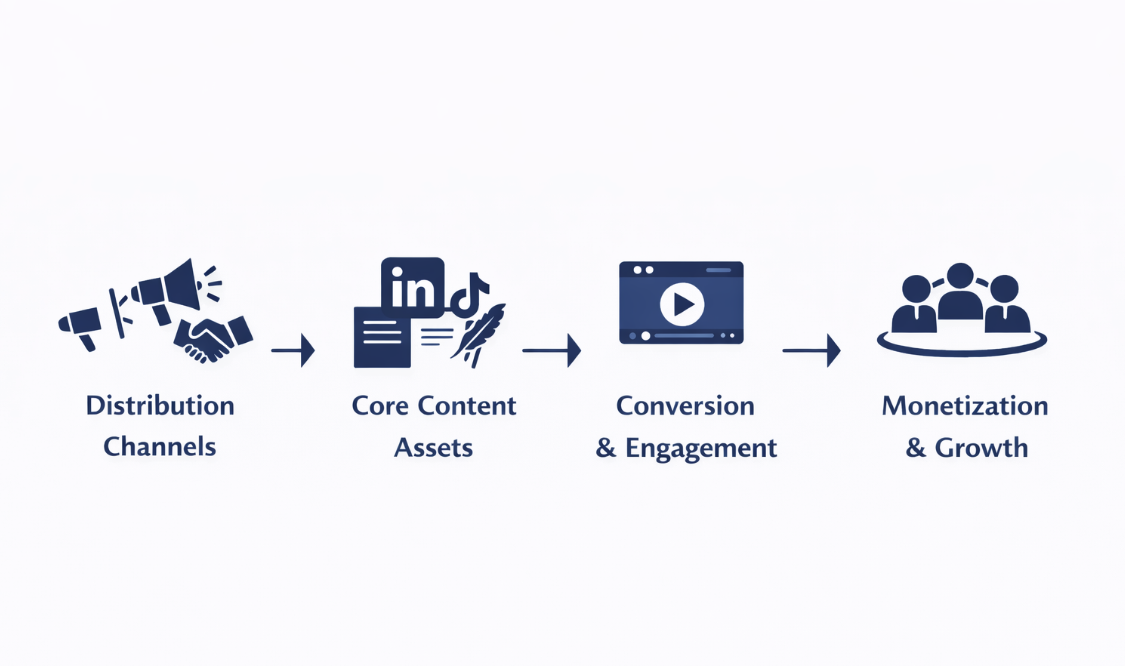
The Content Marketing Strategy is explicitly grounded in the Endgame Marketing Process Map (reach out for more details), which defines how attention flows from distribution channels into owned assets, conversion mechanisms, and revenue outcomes
At a high level, the process map organizes marketing into four layers:
Traffic & Distribution Channels
Core Content Assets
Conversion & Relationship Mechanisms
Revenue Outcomes
Content strategy is responsible for ensuring these layers are intentionally connected.
Content Strategy Framework
1. Traffic & Distribution Strategy
Content strategy begins with an understanding of where attention originates.
Distribution channels may include:
Paid advertising
Organic content platforms (e.g., LinkedIn, YouTube, Twitter)
Partnerships, affiliates, and joint ventures
Direct outreach and media placements
The role of content at this stage is to capture attention and establish relevance.
Strategic questions addressed:
Which channels are best suited for our target segments?
What content formats perform best on each platform?
How does content signal credibility and differentiation?
2. Core Content Asset Design
Once attention is captured, content must deliver depth, trust, and clarity. Core content assets may include:
Website content and landing pages
Case studies and testimonials
Long-form video series or educational resources
Thought leadership articles and research-driven insights
These assets serve as the intellectual foundation of the brand and act as reference points across channels. Strategic questions addressed:
What problems does our audience need help understanding?
What content builds authority rather than superficial engagement?
How do we structure content so it remains valuable over time?
3. Conversion & Relationship Mechanisms
Content must ultimately create a transition from consumption to action. Typical conversion mechanisms include:
Lead magnets and gated resources
Email newsletters and nurture sequences
Webinars, workshops, and live sessions
Communities, courses, or programs
This layer transforms content from passive consumption into ongoing engagement. Strategic questions addressed:
What action should follow each content interaction?
How do we exchange value for attention (e.g., email, registration)?
How do we maintain momentum after the first conversion?
4. Monetization & Growth Paths
The final layer connects content to revenue and long-term value creation. Revenue pathways may include:
Sales conversations and appointment setting
One-time services or recurring client engagements
Digital products, courses, or programs
Partnerships, referrals, and white-label relationships
Content strategy ensures that monetization paths are designed upfront, and refined later. Strategic questions addressed:
Which content assets support high-intent conversion?
How do different customer types monetize differently?
How does content support upsell, retention, and lifetime value?
Measurement & Analytics Integration
Content performance is evaluated across multiple dimensions:
Distribution performance (reach, engagement, traffic quality)
Conversion performance (lead capture, email engagement, event attendance)
Revenue contribution (assisted conversions, sales influence)
Lifecycle performance (repeat engagement, retention, advocacy)
Analytics ensures content strategy remains adaptive rather than static.
Expected Outcomes
Clients engaging in Content Marketing Strategy services can expect:
A clearly defined content system tied to business outcomes
Improved efficiency across content production and distribution
Stronger alignment between marketing, sales, and product messaging
A scalable framework for thought leadership and demand generation
Any questions? Email me: mike@endgameanalytics.com